EASE — Educate, Act, and Sustainably Share for Climate and Environmental Health

The EASE (Educate, Act, Sustainably Share for the Environment) project, funded by Erasmus+ KA220-SCH – Cooperation Partnerships in School Education, brings together teachers, trainers, researchers, and digital experts around a shared goal.
EASE — Educate, Act, and Sustainably Share for Climate and Environmental Health
A European project supporting teachers and the fight against climate change
The EASE (Educate, Act, Sustainably Share for the Environment) project, funded by Erasmus+ KA220-SCH – Cooperation Partnerships in School Education, brings together teachers, trainers, researchers, and digital experts around a shared goal :
to make science education a powerful lever for action in the face of climate disruption and environmental health challenges.
As our planet faces unprecedented changes, teachers play a key role in helping young people understand, question, and take action.
EASE provides them with practical resources, accessible scientific data, and innovative training to teach science differently — with rigor, creativity, and optimism.
Clear and ambitious objectives
EASE aims to :
- Encourage girls’ engagement in science education, paving the way for gender equality and a European future where scientific careers are open to everyone;
- Train and support teachers through active, interdisciplinary, and reality-based teaching practices;
- Connect classroom learning to real-world environmental and climate challenges using data from sensors and field observations;
- Turn eco-anxiety into engagement, empowering students and teachers to take informed, positive action;
- Build a European community of STEM educators committed to sustainability and environmental health education.
STEM disciplines at the heart of the project
EASE focuses on all STEM disciplines — Biology and Earth Sciences, Mathematics, Engineering Sciences, and Computer Science.
The project promotes a cross-disciplinary and hands-on approach to science education, encouraging the use of digital tools, environmental sensors, and real-world data to explore climate and health phenomena.
It also includes certified training courses and a university degree dedicated to climate and environmental health education.
A collaborative structure
Four work packages
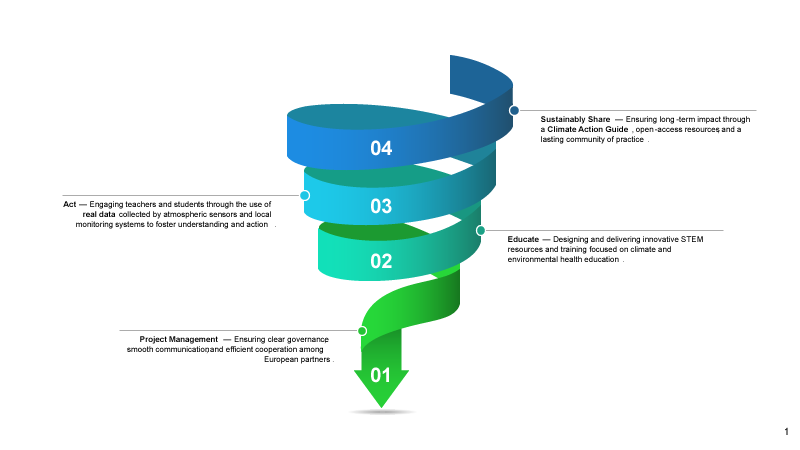
A collaborative structure built around four modules
- Project Management — Ensuring clear governance, smooth communication, and efficient cooperation among European partners.
- Educate — Designing and delivering innovative STEM resources and training focused on climate and environmental health education.
- Act — Engaging teachers and students through the use of real data collected by atmospheric sensors and local monitoring systems to foster understanding and action.
- Sustainably Share — Ensuring long-term impact through a Climate Action Guide, open-access resources, and a lasting community of practice.
Timeline
Summer school : July 27 – 31, 2026
Project partners
The EASE consortium brings together four partners from three European countries, united by a shared conviction:
Teaching science is already acting for the planet and for human health.
EAFC Nice – Ecole Académique de la Formation Continue (France)
Project coordinator, EAFC Nice leads governance, administrative coordination, and pedagogical oversight. As a key player in teacher professional development in France, it promotes scientific culture, international cooperation, and the co-construction of innovative educational practices across Europe.
INSPE de Nice – Institut National Supérieur du Professorat et de l'Éducation de l'Académie de Nice (France)
An academic partner of the project, INSPE de Nice brings its expertise in teacher training, both initial and in-service. Its role is central in designing training pathways, testing innovative pedagogical approaches, and supporting teachers as they integrate environmental and health issues into their teaching.
NIEP – National Institute for Earth Physics (Bucharest, Romania)
NIEP, through its GeoEduLab – Applied Geophysics, Prevention, and Education Laboratory, contributes to EASE as a research and education partner. It integrates Earth and climate science with STEM education, developing hands-on tools and training to help teachers and students use real data for understanding climate and environmental change..
Richard-Hallmann-Schule (Trappenkamp, Germany)
A forward-thinking school committed to pedagogical innovation, Richard-Hallmann-Schule contributes its on-the-ground experience in climate, science, and digital education. It tests EASE materials in real classroom contexts and involves both teachers and students in hands-on and participatory science activities, helping to anchor the project in everyday educational reality.
Open and collaborative governance
A multidisciplinary steering committee — composed of scientists, educators, and engineers — ensures the scientific and pedagogical quality of the project’s outputs.
EASE’s progress will be shared through:
- biannual newsletters,
- European meetings,
- and training sessions open to all teachers interested in innovation and sustainable education.
Join the EASE community !
Together, we empower teachers to inspire the next generation of changemakers in science, climate and environmental health.
By joining the EASE network, teachers can :
- Receive project newsletters
- Test EASE educational resources
- Take part in seminars, summer schools and webinars
Coming soon : the registration form !

« The European Commission is not responsible for any uploaded or submitted content.
Such content expresses the views of its author(s) only »
The EASE (Educate, Act, Sustainably Share for the Environment) project, funded by Erasmus+ KA220-SCH – Cooperation Partnerships in School Education, brings together teachers, trainers, researchers, and digital experts around a shared goal.
Mise à jour : juillet 2026